
Comet Eater: Interview with Terra Keck
Keck describes her practice, method, and inspiration.

Hi to all my Readers,
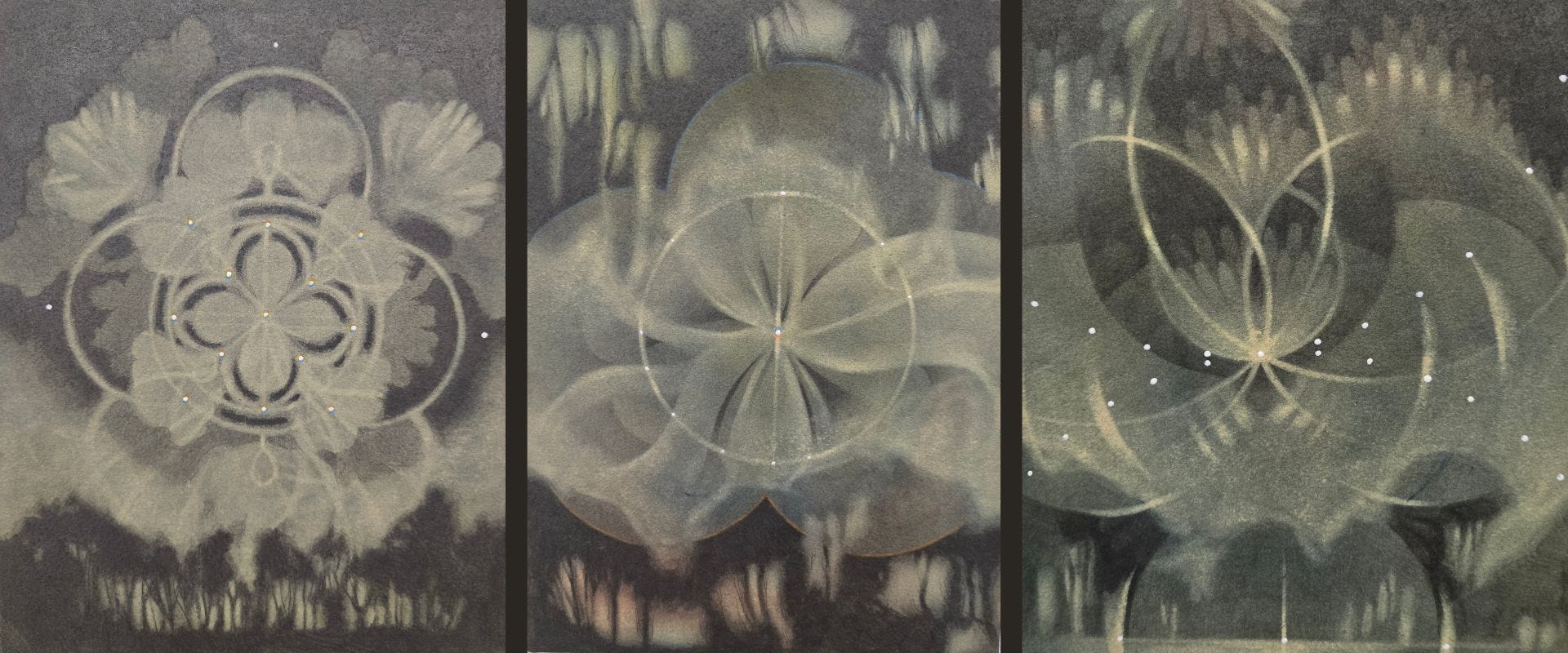
I hope you’re enjoying all the events of Armory week! Between the openings and parties, it can be difficult to catch your footing and figure out what to prioritize. Well, I’m here, with an exhibition for your ⋆·˚ ༘ *priority list *ੈ✩‧₊˚. Terra Keck’s Comet Eater at Storage, is a spiritually informed celestial journey. Through her creative technique of subtraction, darkness is an integral element within her work, as a backdrop and foil; she creates movement through light with intentional erasure.
I had the pleasure of catching an art talk at Storage on Wednesday, August 20th between Keck and Olivia Springberg (who’s work I also covered). Afterwards, Keck and I connected, and I loved her practice so much I wanted to share it and the influences behind her practice with you all.
Comet Eater will be at Storage from August 8th to September 13, 2025.
Oceana: You're currently showcasing Comet Eater at Storage. Can you give us some background on that title?
Terra Keck: Yes! When I have ideas for titles of pieces, shows, or little snippets of poets, I write them on my studio wall (please don’t tell my landlord). A few I’m looking at right now are “Being Eaten by a Tiger the Size of the Universe” and “Does The Sun Shine on Me?” Not all of them are stellar winners but they function as a breadcrumb trail through my studio practice. I’ve found a lot of times any detour I take in the studio is just a roundabout way of coming back to myself.
Comet Eater was a title I’ve had on the wall for about two years, and it’s brushed up against a few pieces over that time. Comets inhabit a similar space as eclipses in historical astrology, as omens of change. They were considered signs from god or gods, foretelling the end of empires, the deaths of kings, or great disasters. In modern times, comets are these exciting astronomical events that remind us that regardless of what’s happening here on earth, all the while there are these ancient travelers hurdling through space, returning to us again and again. They feel alien but some of them are as tied to our origins as our own planet, because they are left over from the birth of our solar system.
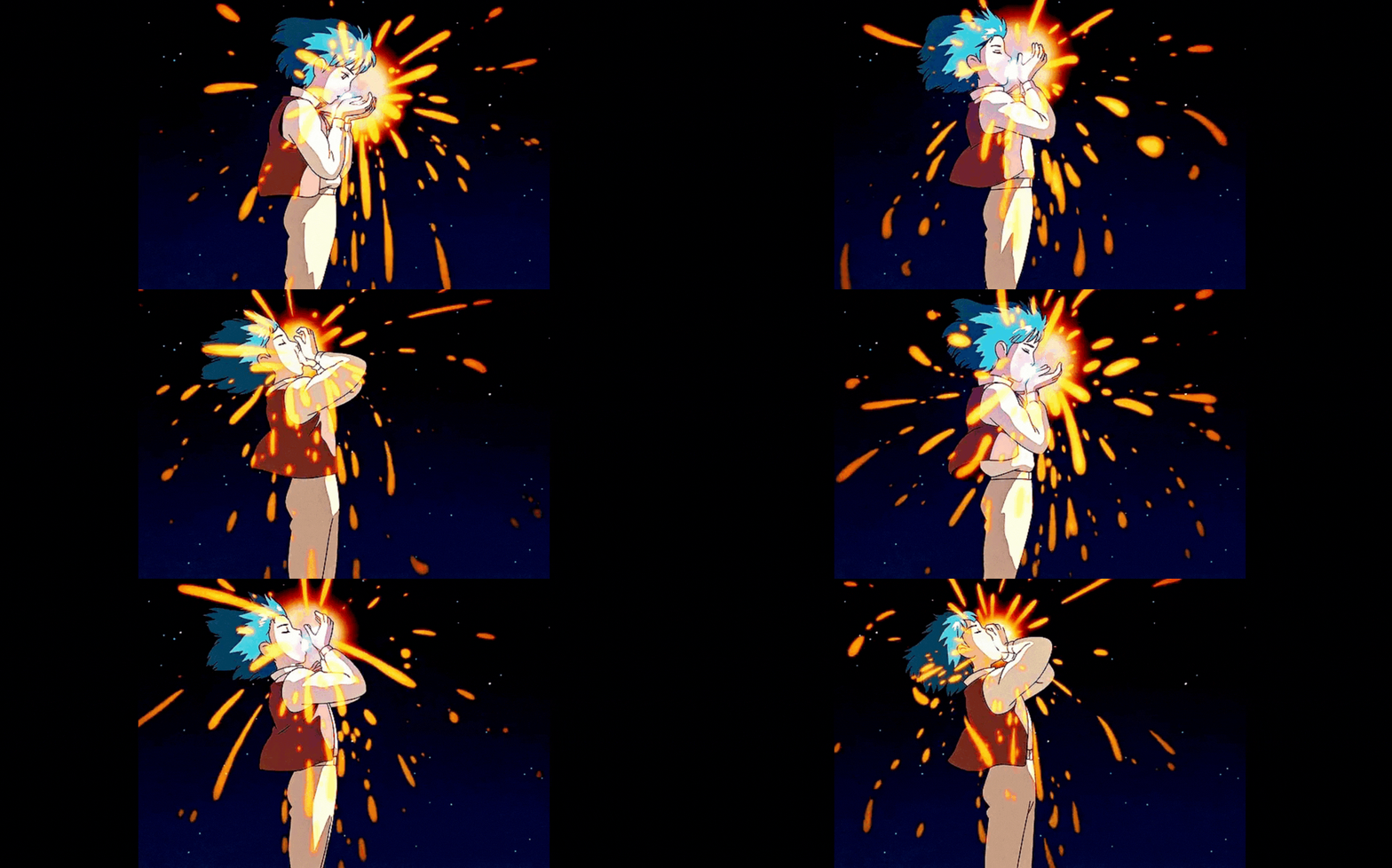
When the titling of this exhibition came up, I stared at my studio wall and I tried to return to myself. And, in this moment I was reminded of the artist, Hayao Miyazaki. I think about his work a lot and there’s a scene in his movie Howl’s Moving Castle, where young Howl is seen marveling at the sky as he walks through a field. Raining down from the sky are hundreds of prismatic stars that run like frantic children until they make contact with something. Young Howl catches one, and eats it, offering up his human heart for the power of this star being. This scene is an exchange of power, a handshake of fate, but it’s also a wish for the future. I think this exhibition in a lot of ways is an offering up of my own heart for a wish.
Your drawings are made through erasure rather than addition. What first drew you to this method? How has it shaped the way you think about making art?
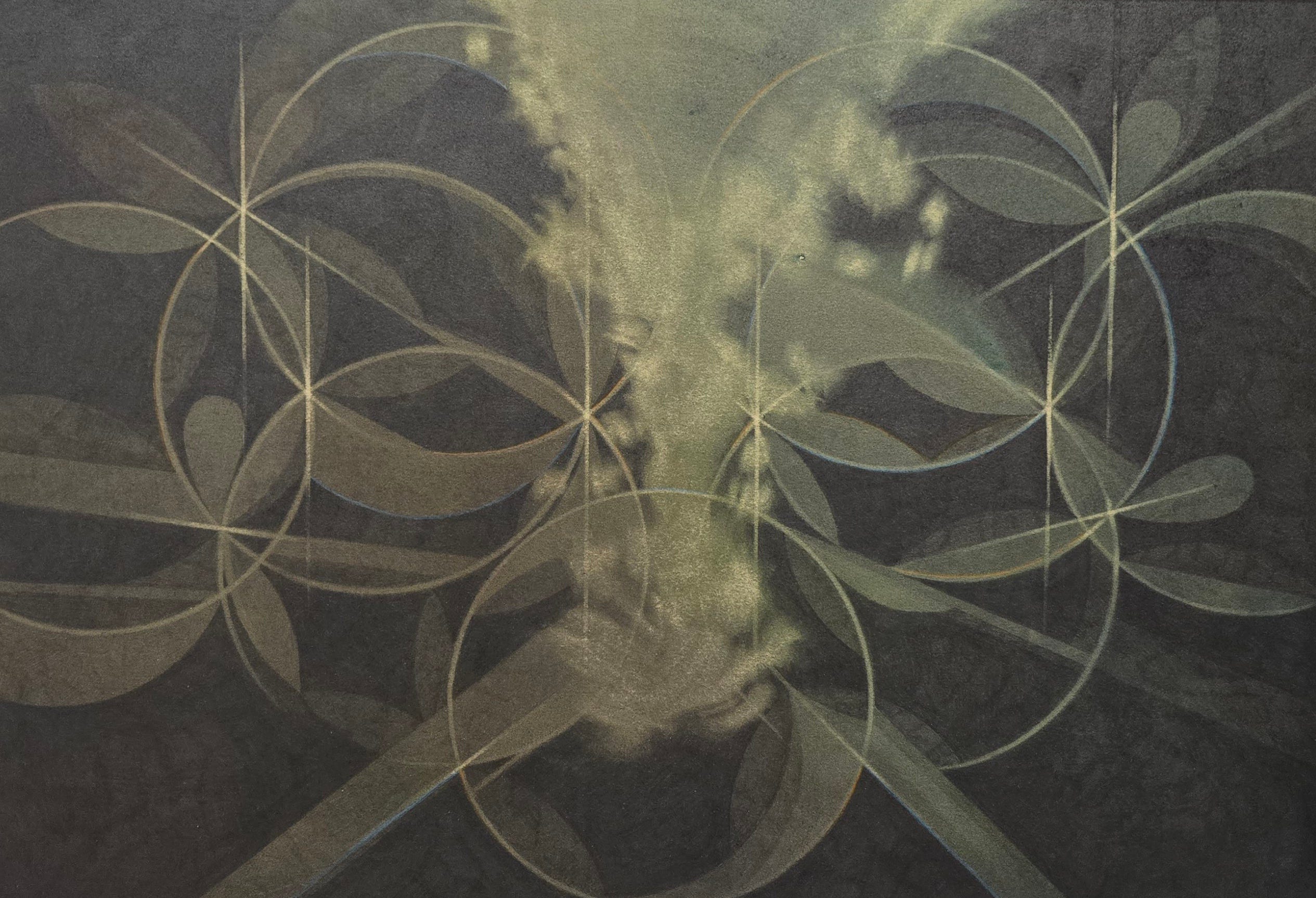
My academic background is in printmaking, specifically woodcut, so I often tell people that the act of removing material just comes natural to me. What initially drew me to woodcut is that it was the first time in my art practice I was surprised by a piece I made. There’s just enough blind removal from control that I felt like I was along for the ride just as much as the viewer. I also think I have a real affinity for edges. The edge of the paper, the edges of a form on that paper, the psychic edge of an idea that I’m bumping up against. There’s a story of 4 blind men describing an elephant. One touches the trunk and says that the elephant is long and wiggly like a snake, and another touches the leg and says that the elephant is strong and thick like the trunk of an oak tree, and so on. When I begin a piece I’m really just bumping up on the edges of what’s already there, feeling my way around it until I can start to understand the full picture.
I think eraser drawings are also a really nice way to eliminate the anxiety of beginning a piece because the first step is the annihilation of the blank page. There’s something really satisfying and relieving about a fully dark page.
Growing up, were there any visual traditions, folklore, or pop culture that shaped your imagination early on?
As a kid, I was completely drawn in by anime and manga. It probably started with Sailor Moon and Dragon Ball Z, and then expanded as Toonami’s lineup grew into Adult Swim on Cartoon Network. I remember watching Hayao Miyazaki’s Kiki’s Delivery Service for the first time. It felt like it exploded my brain. For my 11th birthday, I saw Spirited Away in theaters and immediately spent all $15 of an iTunes gift card just to download the soundtrack. I think what I loved about anime is that so much of it revolves around characters dealing with the fact that the world is infinitely more magical and strange than they imagined. There are a lot of complex female protagonists who have an innate power to them, and their success relies on them leaning into that power.
Around that same time, my oldest sister was moving across the country to Washington, D.C., and she was getting rid of a bunch of books and jewelry. She gave me this massive illustrated book on world mythology. It was easy reading, but the content was completely foreign to me. It has stories of animism, underground origins for humanity, and Hindu apocalypses. It introduced me to these wild, cosmic worldviews at a really young age. Looking back, I think all of that primed me for my own kind of spiritually promiscuous point of view.
You’ve described your art as a form of mediumship. What kinds of stories, voices, or presences are you channeling?
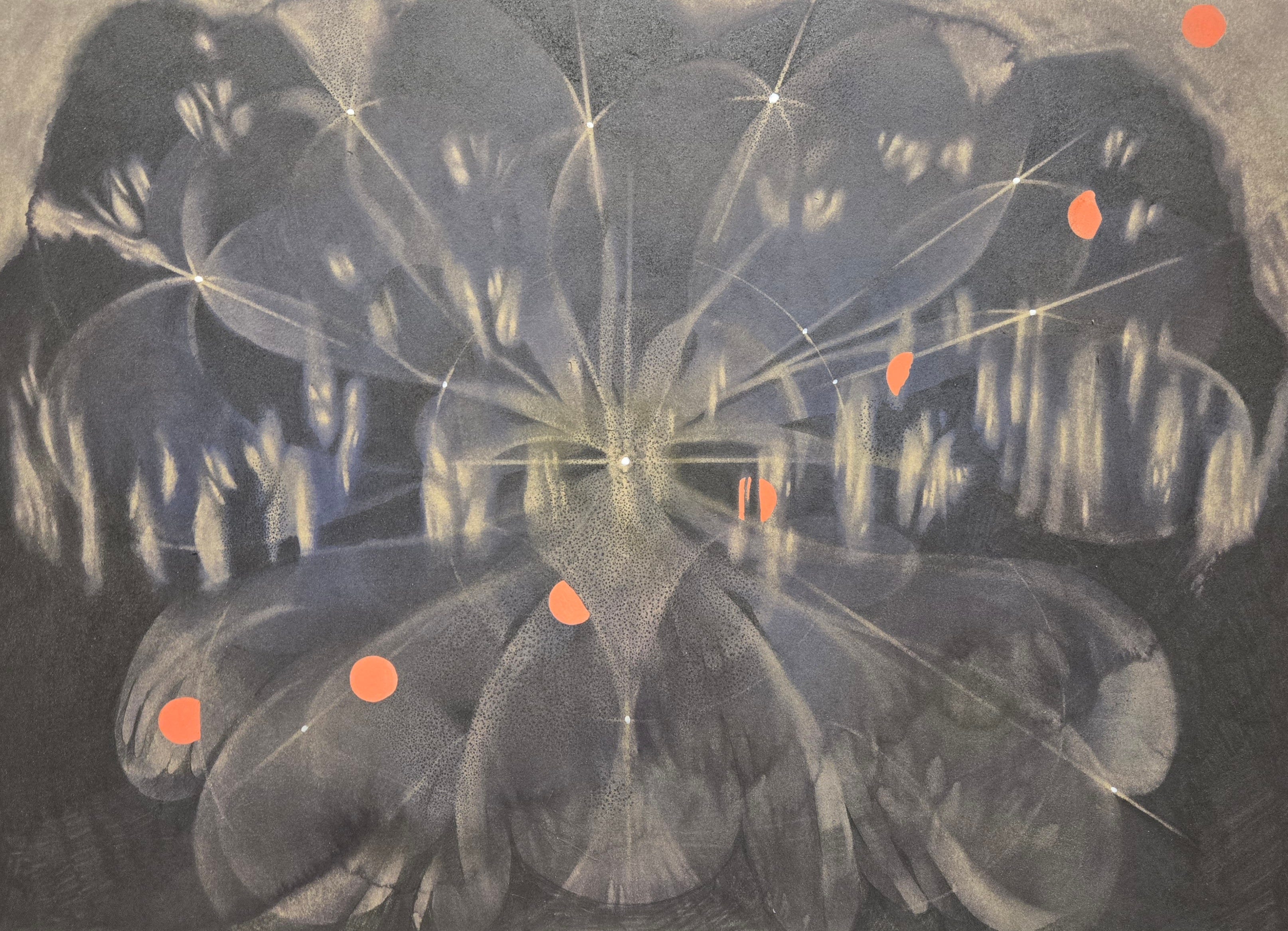
I recently had a reiki session where the practitioner described my third eye as a beautiful garden of flowers, and I’ve been testing that as a way to describe my practice. I think of ideas (poems, songs, artworks) as living creatures that choose an artist and use us as a conduit to be born into this plane. Every artist knows the ache of trying to force something into existence, or the disappointment of a piece that feels like it lacks a soul.
So, a lot of my life is in service to becoming an attractive host. I’ve been calling my studio a “nest” because I want ideas to feel like they have something soft to land in. But, maybe a garden is more fitting; a place where they can linger, marvel, and grow. I sense that ideas are a lot like birds. They remember you. And they like when you leave them gifts; little trinkets of making: a drawing here, a poem there. The more you leave offerings on the altar of your studio, the more they’ll return, bringing their sparkling new ideas with them.
How has living and working in Brooklyn shifted your approach to art making vs. your time in Hawai‘i?
When I was in Hawai‘i, I was in graduate school working toward my MFA, so part of the work was always tied to being a “good MFA student.” It was full of research, historical references, and the panicked pressure to say something. After moving to Brooklyn, it took about five years to shake that mindset though it still sneaks up on me sometimes.
Aesthetically, my work in Hawai‘i was very bodily, bright colors, raw textures, and conceptually rooted in the idea of the demonic feminine, almost like a Lilith counterpart to the divine feminine. Looking back, that was probably influenced by being 24 and navigating the political atmosphere between 2015 and 2018. When I left Hawai‘i, I stayed in that headspace for a while, but over time, the work stopped feeling honest.
If we can reference a previous question, there’s a moment in Kiki’s Delivery Service that really resonates with me. When Kiki loses her powers, she visits the painter, Ursula. Who tells her about a time she too had felt she lost her power to paint; that she was just making copies of paintings she’d seen somewhere before, “and not very good copies either.” That’s exactly how I felt during those first few years in New York. Sometimes even like I was copying my own work, just to legitimize it.

The big shift happened when I moved from an “idea first, execution second” mindset to an “execution first until the idea reveals itself” approach. That changed everything. Not only did people start responding to the work more, I finally liked it too. For the first time in a long time. And what started showing up surprised me: real, honest areas of research and authentic interests. It felt like coming home. I believe I may have mentioned this after my artist talk, but just telling the truth about who I am and what I love to draw changed my entire life. It seems so simple but it’s a daily practice for me.
Your practice has moved from smaller-scale drawings to larger, more ambitious projects. Where do you see it evolving next?
Since my exhibition at Storage, I’ve been experimenting with adding different mineral pigments to my graphite, trying to create more anomalous, unexpected interactions in the early stages of making. I’ve also started placing cut-outs and small “somethings” beneath the paper to subtly disrupt the surface, letting those distortions guide the work. But these are just at the “play stage” of my studio practice.
Lately, I’ve been dreaming about a chapel. Whenever I’m in airports, I make a point to visit the little chapels tucked away in quiet corners. Sometimes you find them at rest stops too, out in the middle of nowhere (usually those smell like weed). Beyond that I’m just resuming worship at the alter of my studio. I leave offerings daily. There’s a word I’ve had pinned to my wall for a while now: moon cathedral.
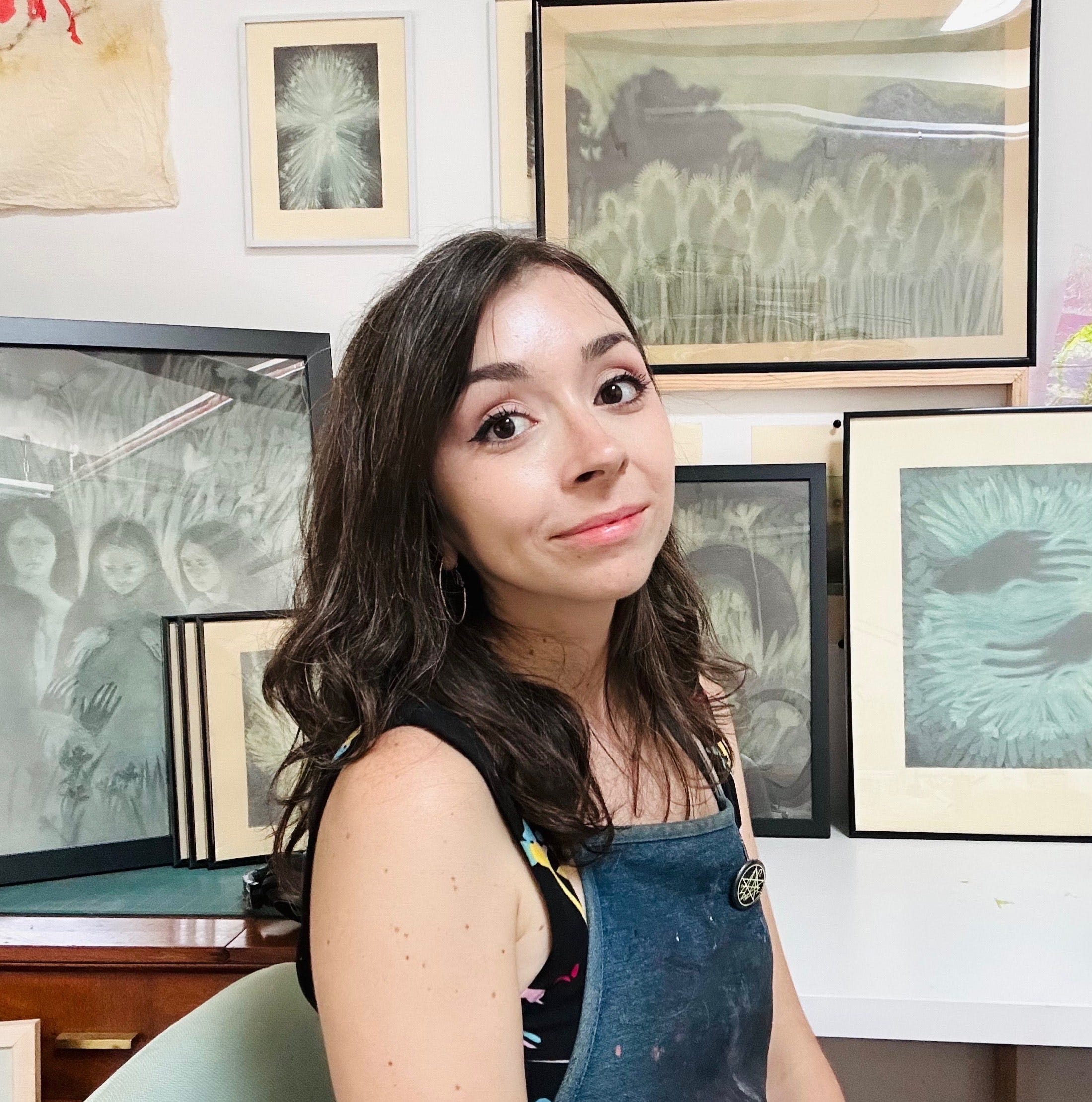
You can keep up with Keck through her socials:
Thanks for reading ✎ (❁ᴗ.ᴗ͈) ༉‧ ♡*.✧